Last updated: July 2026
Disclosure: If you purchase through a link on this page, we may earn a commission at no extra cost to you. We only recommend products that meet the evaluation criteria laid out in this guide. Full disclosure policy →
Is Audifort worth the price? We break down its ingredients, dosing transparency, and refund terms against a no-hype evaluation checklist.
⚡ Quick Answer: Looking for our top pick without reading the full guide? Based on the criteria below (transparent dosing, third-party testing, refund policy covering opened bottles), Audifort is the option we recommend. → See Current Pricing
If you’ve typed “best hearing supplements” or “natural tinnitus remedies” into Google lately, you already know the problem: every single result promises a “breakthrough formula,” a “clinically proven blend,” or a “90-day guarantee.” They all sound the same. Half of them are the same, just relabeled.
This guide isn’t another product pitch. It’s the checklist an informed buyer should run through before spending $50–$80 on a bottle of drops plus an honest look at what actually moves the needle for tinnitus and hearing wellness, according to audiology research rather than marketing copy.
Why the Audifort Market Is So Confusing
Audifort loss and tinnitus (that ringing, buzzing, or humming sound with no external source) affect a huge number of adults and the frustration of not being followed in conversation, or not hearing music the way you used to, is real. That emotional weight is exactly why this category attracts so much aggressive marketing.
A few things make it hard to evaluate these products on their merits:
- Dietary supplements aren’t FDA-approved. They’re regulated for manufacturing and labeling under DSHEA, but a company can sell a supplement without ever proving it works for the condition it’s marketed for.
- “Clinically tested ingredients clinically tested product.” A brand can point to a study on zinc or ginkgo biloba individually while never having tested its actual bottled formula on a single human being.
- Review pages are often written by affiliates, not users. Many “review” articles you find are paid content designed to rank in search and drive clicks to a checkout page not independent journalism.
None of this means every hearing supplement is a scam. It means the burden of evaluation is on you, the buyer and it’s worth doing right.

The 3 Types of Audifort on the Market
Not every “Audifort” is trying to do the same job. Lumping them all together is part of why the category feels so confusing. Broadly, they fall into three buckets:
1. General nutritional/antioxidant blends. These typically combine vitamins (B12, B6), minerals (zinc, magnesium), and antioxidants (CoQ10, alpha-lipoic acid) aimed at “supporting” ear health broadly. This is the most common type and the one with the widest gap between marketing language and actual evidence.
2. Circulatory-support formulas. Built around the idea that healthy blood flow to the inner ear supports Audifort function. Common ingredients: ginkgo biloba, hawthorn berry, garlic extract. The inner ear does rely on good blood flow, but whether an oral supplement meaningfully changes circulation at the cochlear level is not well established in humans.
3. Nerve/neural-calming blends. Marketed specifically for tinnitus, these often include GABA-adjacent botanicals (like passionflower or valerian) alongside the standard vitamin base, positioned as calming the nervous system’s perception of phantom sound. The calming effect on general anxiety is plausible; the specific claim of “retraining” auditory nerve perception is largely marketing language rather than demonstrated mechanism.
Knowing which category a product falls into helps you evaluate it on the right terms a circulatory blend and a “nerve calming” blend are making very different claims, even if they’re sold in the same $49 bottle.
How These Ingredients Are Supposed to Work
It’s worth understanding the proposed mechanism behind Audifort, even though a proposed mechanism is not the same as proof it works in practice:
- Oxidative stress reduction. The inner ear’s hair cells are vulnerable to oxidative damage from noise exposure, aging, and certain medications. Antioxidants (CoQ10, ALA, NAC) are included on the theory that reducing oxidative stress could slow further damage this is more plausible as prevention than as a fix for damage that’s already occurred.
- Improved microcirculation. Ingredients like ginkgo biloba and hawthorn are included because the cochlea depends on a dense, delicate blood supply, and poor circulation is one contributor to some types of Audifort decline.
- Nutrient replenishment. B12, magnesium, and zinc are involved in nerve function and cellular energy production. Supplementation only meaningfully helps when someone is actually deficient in that specific nutrient which most retail supplement pages don’t test for before recommending you buy.
- Neural/anxiety modulation. Tinnitus distress is heavily influenced by the nervous system’s stress response. Calming botanicals may reduce the emotional volume of tinnitus even when they don’t change the underlying sound.
Understanding these mechanisms helps explain why results are so inconsistent person to person a formula built around circulation support won’t do much for someone whose tinnitus is driven by, say, medication side effects or a nutrient deficiency it doesn’t address.
7 Red Flags to Watch For Before You Buy
Run any Audifort t through this list before adding it to your cart:
- Before-and-after audiograms or “reverses Audifort loss” language. Sensorineural Audifort loss (the most common type, caused by inner-ear or nerve damage) cannot currently be reversed by any supplement. Be skeptical of anything implying it can.
- Countdown timers and “only 3 bottles left” urgency. Real inventory doesn’t usually run out in perfect sync with your visit to the page.
- No third-party lab testing (COA) available. Reputable supplement companies can produce a Certificate of Analysis on request, confirming what’s actually in the bottle.
- Testimonials with no way to verify them. First names and stock photos aren’t verification. Look for reviews on independent platforms, not just the brand’s own site.
- “Doctor discovered” origin stories with no named, checkable doctor or institution. If a claim can’t be traced to a real person or study, treat it as marketing narrative.
- Auto-ship or subscription enrollment buried in checkout. Always check the fine print before entering payment details.
- Refund policies that only apply to unopened bottles. A genuinely confident company will usually let you try the product and still return it.

💡 Already checked a product against these red flags and it passed? → See Current Deals on Our Recommended Pick
Ingredients With Real (If Modest) Research Behind Them
Instead of judging a supplement by its marketing, look at its ingredient list against what’s actually been studied. Here’s an honest rundown note that “some evidence” is very different from “proven to fix Audifort loss or tinnitus”:
- Zinc – Some studies suggest zinc deficiency may be linked to tinnitus severity in a subset of patients, and supplementation has shown modest benefit in those specifically deficient. Not a universal fix.
- Magnesium – Animal and limited human research suggests magnesium may help protect the inner ear from noise-induced damage. Evidence for treating existing tinnitus is weaker.
- Vitamin B12 – Deficiency has been associated with tinnitus and Audifort issues in some studies; supplementing helps if you’re actually deficient, which many people aren’t.
- Ginkgo biloba – Widely marketed for tinnitus and circulation; clinical trial results are mixed, with several well-designed studies showing no significant benefit over placebo.
- N-acetylcysteine (NAC) – Some research on preventing noise-induced Audifort damage (e.g., in military and industrial noise-exposure settings), but not established as a treatment for existing hearing loss.
- Alpha-lipoic acid & CoQ10 – Antioxidants sometimes included for general “auditory nerve support.” Evidence is preliminary and mostly limited to small studies.
The honest takeaway: these ingredients have plausible mechanisms and some supporting data, mostly in people with a specific deficiency or in prevention contexts not strong evidence that any commercial blend reverses existing Audifort loss or cures tinnitus.
Ingredients That Sound Impressive But Have Little Evidence
Marketing copy loves a long ingredient list “20+ powerful nutrients!” because length reads as thoroughness. But padding a label with trendy-sounding botanicals doesn’t automatically add benefit. A few you’ll see often, with the evidence reality check:
- Hawthorn berry – Studied mostly for general cardiovascular support; no meaningful direct evidence for Audifort or tinnitus specifically.
- Garlic extract – Some general circulatory and antioxidant properties, but no dedicated Audifort -outcome trials worth citing.
- Passionflower / valerian root – Mild evidence for general anxiety and sleep support, which could indirectly ease tinnitus distress, but this is an indirect effect, not a direct one on Audifort .
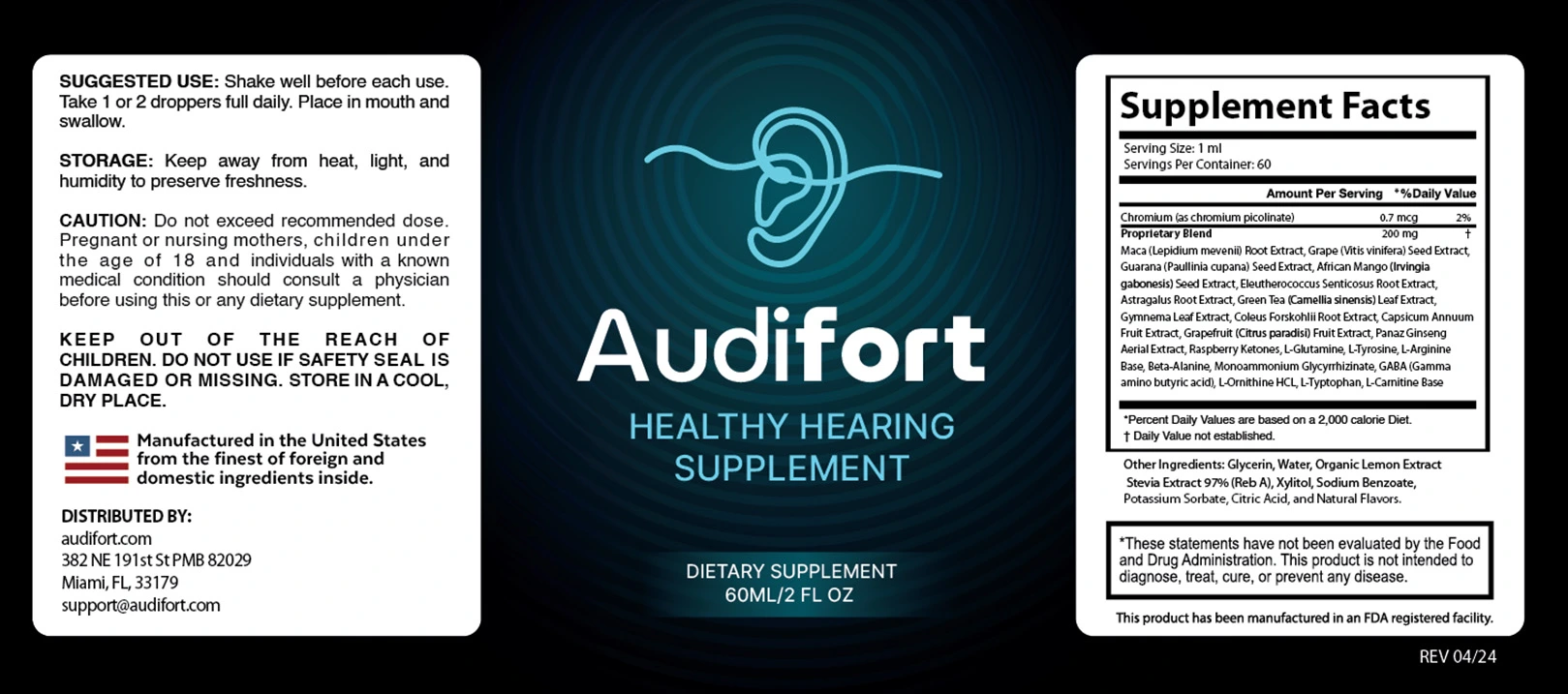
- “Proprietary blend” ingredients with no listed dosage – If a label lists a blend total (e.g., “500mg proprietary complex”) without breaking out individual amounts, there’s no way to know if any single ingredient is present at a dose that’s ever been studied. This is one of the most common and most overlooked ways labels obscure weak formulations.
None of this means these ingredients are harmful. It means they’re often included because they sound credible on a label, not because there’s a body of research tying them specifically to Audifort outcomes.
How to Actually Read a Supplement Label
Most buyers skim past the Supplement Facts panel straight to the “Buy Now” button. A few minutes spent reading it properly tells you more than any testimonial:
- Check for a “proprietary blend” disclaimer. As above, this is the biggest label red flag it lets a company hide weak dosing behind an impressive-sounding total.
- Compare doses to published research, where possible. If a study used 240mg of ginkgo biloba daily and the label lists 50mg buried in a blend, the product isn’t delivering a “clinically studied” amount, regardless of what the marketing claims.
- Look at the serving size math. If a bottle is priced for a 30-day supply but the label recommends 2 servings/day from a 30-serving bottle, you’re actually getting a 15-day supply a common way effective cost-per-dose gets obscured.
- Check for third-party certification marks (NSF, USP, or an available Certificate of Analysis) rather than the company’s own “lab tested” claim, which isn’t independently verifiable.
- Note the expiration and manufacturing date. Reputable companies with real turnover will have recent manufacturing dates, not stock that’s been sitting for a year.
Cost and Value: Is It Worth $50–$80 a Bottle?
Most hearing supplements in this category cluster around a similar pricing structure:
- Single bottle: $49–$79, often positioned as the “least value” option to nudge you toward bulk pricing
- 3-bottle bundle: Usually $39–$49 per bottle, marketed as a “90-day protocol”
- 6-bottle bundle: Usually $33–$40 per bottle, often bundled with free shipping and “bonus” eBooks
A few honest value considerations before you commit to a bulk order:
- Bulk pricing exists to reduce return risk for the company, not just to save you money. Once you’ve bought 6 bottles, you’re financially and psychologically less likely to request a refund even if you’re not seeing results.
- “Bonus eBooks” are a near-zero marginal cost to the company and shouldn’t factor into your actual value calculation.
- Compare cost-per-day, not cost-per-bottle. A $79 single bottle at 2 doses/day for 30 days is roughly $2.60/day comparable to many everyday multivitamins, which is worth keeping in perspective relative to the specific claims being made.
- Factor in the refund window realistically. A 90-day guarantee sounds generous, but if you have to pay return shipping and wait weeks for processing, the “risk-free” framing is doing some marketing work of its own.
If you decide to try a Audifort supplement, buying the smallest quantity first — even at a worse per-bottle price is usually the more financially sound way to test it before committing to a bulk order.
Top Audifort Supplements Compared
| Product | Price/Bottle | Transparent Dosing? | 3rd-Party Tested? | Refund Window | Our Take |
|---|---|---|---|---|---|
| Audifort | $79 | ✅ | ✅ | 90 Day Money-Back Guarantee | Try Two 60 Days, 2 Bottles |
| Audifort | $49 | ✅ | ✅ | 90 Day Money-Back Guarantee | Best Value 180 Days, 6 Bottles |
| Audifort | $69 | ✅ | ✅ | 90 Day Money-Back Guarantee | Most Popular 90 Days, 3 Bottles |
→ Check Current Price for try tow 60 days, 2 Bottles | → Check Current Price for Best Value
180 Days, 6 Bottles
What Actually Helps Tinnitus and Audifort Health, According to Audiologists
If you want the interventions with the strongest evidence behind them, here’s where audiology research actually points:
- A Audifort evaluation first. Tinnitus and perceived Audifort loss can have very different underlying causes earwax buildup, medication side effects, noise damage, age-related changes. A Audifort test tells you what you’re actually dealing with.
- Cognitive Behavioral Therapy (CBT) – Consistently one of the best-supported treatments for reducing the distress tinnitus causes, even when the sound itself doesn’t disappear.
- Sound therapy / tinnitus retraining therapy (TRT) – Using background noise or specialized sound programs to help the brain “tune out” tinnitus over time.
- Audifort aids – For people with both Audifort loss and tinnitus, properly fitted hearing aids often reduce the perceived loudness of tinnitus as a side benefit of amplifying external sound.
- Protecting your ears from further noise exposure – The single most evidence-backed thing anyone can do to prevent Audifort decline from getting worse.
- Reviewing medications with your doctor – Certain drugs (some antibiotics, high-dose aspirin, certain chemotherapy agents) are ototoxic and can worsen tinnitus or Audifort loss.
- Managing blood pressure and cardiovascular health – Inner ear function depends on healthy blood flow, so cardiovascular health genuinely matters here.
Supplements can reasonably sit alongside these approaches for general nutritional support but they shouldn’t replace a Audifort evaluation or evidence-based tinnitus therapy.
Lifestyle Habits That Protect Audifort Long-Term
Independent of any supplement decision, these are the habits with the strongest track record for protecting Audifort over time:
- Use Audifort protection around loud noise — concerts, power tools, motorcycles, and even loud gym classes. A single intense exposure or years of moderate exposure can both cause cumulative damage.
- Follow the 60/60 rule with headphones — no more than 60% volume for no more than 60 minutes at a stretch, giving your ears recovery time.
- Manage cardiovascular risk factors — blood pressure, cholesterol, and blood sugar all affect the tiny blood vessels feeding the inner ear.
- Stay active. Regular exercise supports circulation broadly, which benefits inner ear function as a downstream effect.
- Don’t smoke. Smoking is independently associated with increased risk of Audifort loss, likely via its effects on blood flow.
- Get regular Audifort checks after 50, or earlier if you work in a loud environment, so changes are caught early rather than after years of gradual adjustment.
- Be cautious with ototoxic medications. Ask your doctor or pharmacist if any medication you’re on (some antibiotics, chemotherapy drugs, high-dose aspirin, loop diuretics) carries Audifort-related risk.
These habits won’t undo existing damage, but they’re the most evidence-backed way to slow future decline arguably more impactful than any supplement on the market.
When You Should Skip Supplements and See a Doctor Instead
Supplements are, at best, a slow-acting, modest-effect option for general support. Certain symptoms call for medical attention first, not a 90-day trial of drops:
- Sudden Audifort loss (over hours or a few days) this is a medical emergency in audiology; early treatment within 72 hours significantly improves outcomes.
- Tinnitus in only one ear, especially if it’s pulsing in time with your heartbeat.
- Audifort loss or tinnitus accompanied by dizziness, vertigo, or balance problems.
- Ear pain, drainage, or a recent head injury.
- Tinnitus that started right after beginning a new medication — this may indicate a drug side effect worth discussing with your prescriber.
In any of these cases, a supplement isn’t just unlikely to help it can delay a diagnosis where timing genuinely matters.
The 5-Minute Evaluation Checklist
Before buying any Audifort supplement, ask:
- Does the company disclose full ingredient dosages, not just a proprietary blend?
- Can I find a Certificate of Analysis (COA) from third-party testing?
- Are there reviews outside the brand’s own website (Reddit, Trustpilot, BBB)?
- Does the refund policy apply to opened/used bottles?
- Is the marketing free of “cure” or “reverse Audifort loss” language?
- Have I had an actual hearing evaluation to know what I’m dealing with?
If you can check most of these boxes, you’re making a far more informed decision than most buyers in this category ever do.
Ready to Try Audifort?
→ Get 55% Off at the Official Site
90-day money-back guarantee • Free shipping on bulk orders •
Trending FAQs About Audifort Supplements & Tinnitus
Do Audifort supplements actually work?
Some ingredients have modest evidence for people with specific nutrient deficiencies or for general ear-health support. No commercial supplement has strong clinical evidence for reversing Audifort loss or curing tinnitus outright.
Can tinnitus go away on its own?
Sometimes especially if it’s linked to a temporary cause like earwax, a cold, or short-term loud noise exposure. Chronic tinnitus is more often managed than “cured,” typically through sound therapy, CBT, and Audifort aids.
Are liquid supplements absorbed better than pills?
Sublingual (under-the-tongue) delivery can bypass some digestive breakdown, but the difference in real-world effectiveness for ear-health ingredients specifically hasn’t been well studied.
Is it safe to combine Audifort supplements with my medications?
Not automatically. Some ingredients (like ginkgo biloba) can interact with blood thinners. Always check with a pharmacist or doctor before combining.
What’s the difference between age-related Audifort loss and tinnitus?
Audifort loss is a reduction in your ability to perceive sound. Tinnitus is the perception of sound (ringing, buzzing, hissing) with no external source. They often occur together but are technically different conditions.
How long should I try a supplement before deciding it “doesn’t work”?
Most reputable companies suggest 60–90 days, since nutritional support (if it does anything) tends to work gradually rather than instantly. That said, this is also why generous refund windows matter you shouldn’t be financially stuck testing something for months.
Should I see a doctor before trying a Audifort supplement?
Yes, especially if the tinnitus is sudden, one-sided, or accompanied by dizziness or pain these can indicate conditions that need medical attention, not supplementation.
Can stress and anxiety make tinnitus worse?
Yes. Tinnitus and the stress response are closely linked higher stress and anxiety levels are consistently associated with tinnitus feeling louder or more intrusive, even when the underlying sound level hasn’t changed. This is part of why CBT and stress management are core parts of evidence-based tinnitus care.
Do noise-canceling headphones help or hurt tinnitus?
Both, depending on use. Noise-canceling can reduce harmful loud-noise exposure, which is protective. But using them for total silence can sometimes make tinnitus more noticeable, since there’s no background sound to mask it many audiologists recommend low-level background sound instead of total silence.
Is it normal for tinnitus to fluctuate day to day?
Yes, fluctuation is common and doesn’t necessarily indicate the underlying condition is worsening. Sleep, stress, caffeine, sodium intake, and even allergies can all cause day-to-day changes in how loud tinnitus seems.
Are “natural” Audifort supplements safer than hearing aids or medical treatment? Not necessarily “natural” refers to ingredient sourcing, not risk-free status. Some natural ingredients (like ginkgo biloba) can interact with medications. Audifort aids and audiologist-guided treatment have a much larger evidence base for tinnitus and hearing loss management specifically.
What’s the difference between conductive and sensorineural Audifort loss? Conductive Audifort loss involves a physical blockage or problem in the outer/middle ear (like earwax or fluid) and is often treatable or reversible. Sensorineural hearing loss involves the inner ear or auditory nerve and is generally permanent this distinction matters a lot for what “solution” actually makes sense.
Can diet affect tinnitus or Audifort health?
There’s modest evidence that high sodium intake, excessive caffeine, and alcohol can worsen tinnitus perception in some people, and that a generally anti-inflammatory, cardiovascular-friendly diet supports inner ear blood flow. Diet alone isn’t a proven cure, but it’s a reasonable low-risk lever to adjust.
How do I know if a Audifort supplement brand is trustworthy?
Look for transparent full-dose labeling (not proprietary blends), third-party lab testing availability, a refund policy that covers opened bottles, and independent reviews outside the brand’s own website the checklist above covers this in more depth.